Published Data
Comparative Economic Analysis of Response-Guided Titration of Incretin Therapies versus Standard Models: A 6-month Real-World Evaluation in an Integrated, Digital Obesity Clinic
Financial models for incretin-based therapies for obesity typically assume rigid titration schedules, where patients escalate monthly to the maximum maintenance dose (the ‘standard schedule’). However, clinical practice often requires personalised titration based on individual response.

Authors:
Thomas Curtis1, Laura Falvey1, Claudia Ashton1, Hywel Room2, Adrian Brown3, Siri Steinmo4, Dipesh Patel5, Jonathan Kwan6, Barbara McGowan7
Affiliations:
1Reset Health Ltd, London, UK 2Colchester Hospital, East Suffolk and North Essex NHS Trust, UK 3University College London, London, UK 4UCLH, London, UK 5Royal Free Hospital, London, UK 6Darent Valley Hospital, Kent, UK 7Guys & St Thomas Hospital, London, UK
Background:
Financial models for incretin-based therapies for obesity typically assume rigid titration schedules, where patients escalate monthly to the maximum maintenance dose (the ‘standard schedule’). However, clinical practice often requires personalised titration based on individual response. Understanding this cost differential is critical for accurate service planning and commissioning decisions in the NHS. This study aimed to quantify the economic impact of real-world dosing decisions—including switching therapies and maintaining lower doses—compared to standard model expectations, while assessing retention during a 24-week initiation period.
Method:
A retrospective analysis was performed on the digital arm of a specialist obesity service in the NHS (Roczen). From a cohort of 105 patients, 96 were initiating treatment; cost analysis was performed on patients continuing treatment at 24 weeks (n=90). We analysed retention and mean weight loss in patients with complete outcome data. We compared actual medication costs (based on BNF list prices) against a standard schedule of monthly up-titration for the initiating agent (semaglutide or tirzepatide). This standard schedule served as the fixed cost benchmark for all patients, including those who sequentially switched medication (‘switchers’). Dosing decisions (n=610) were categorised to identify standard schedule deviations.
Results:
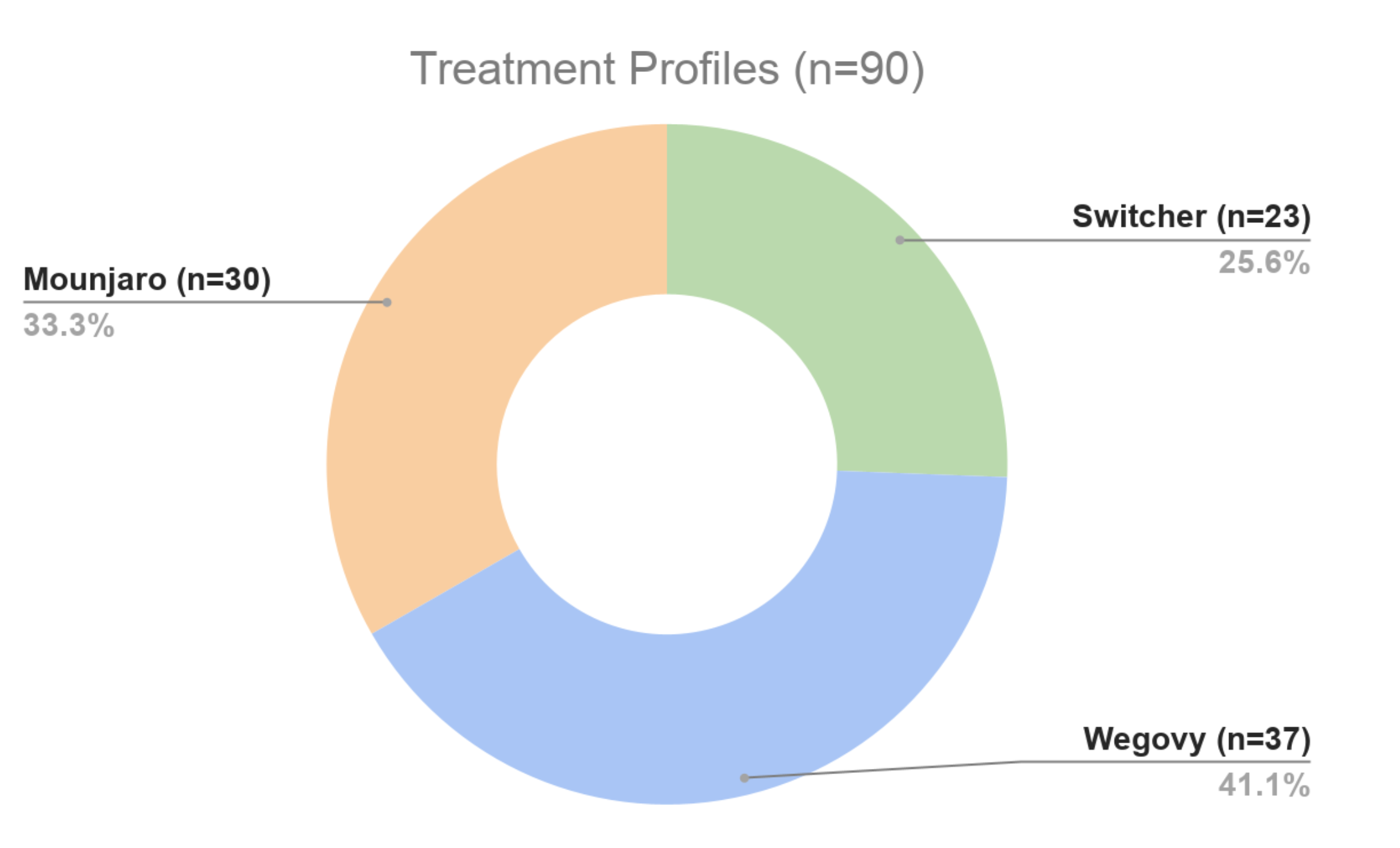
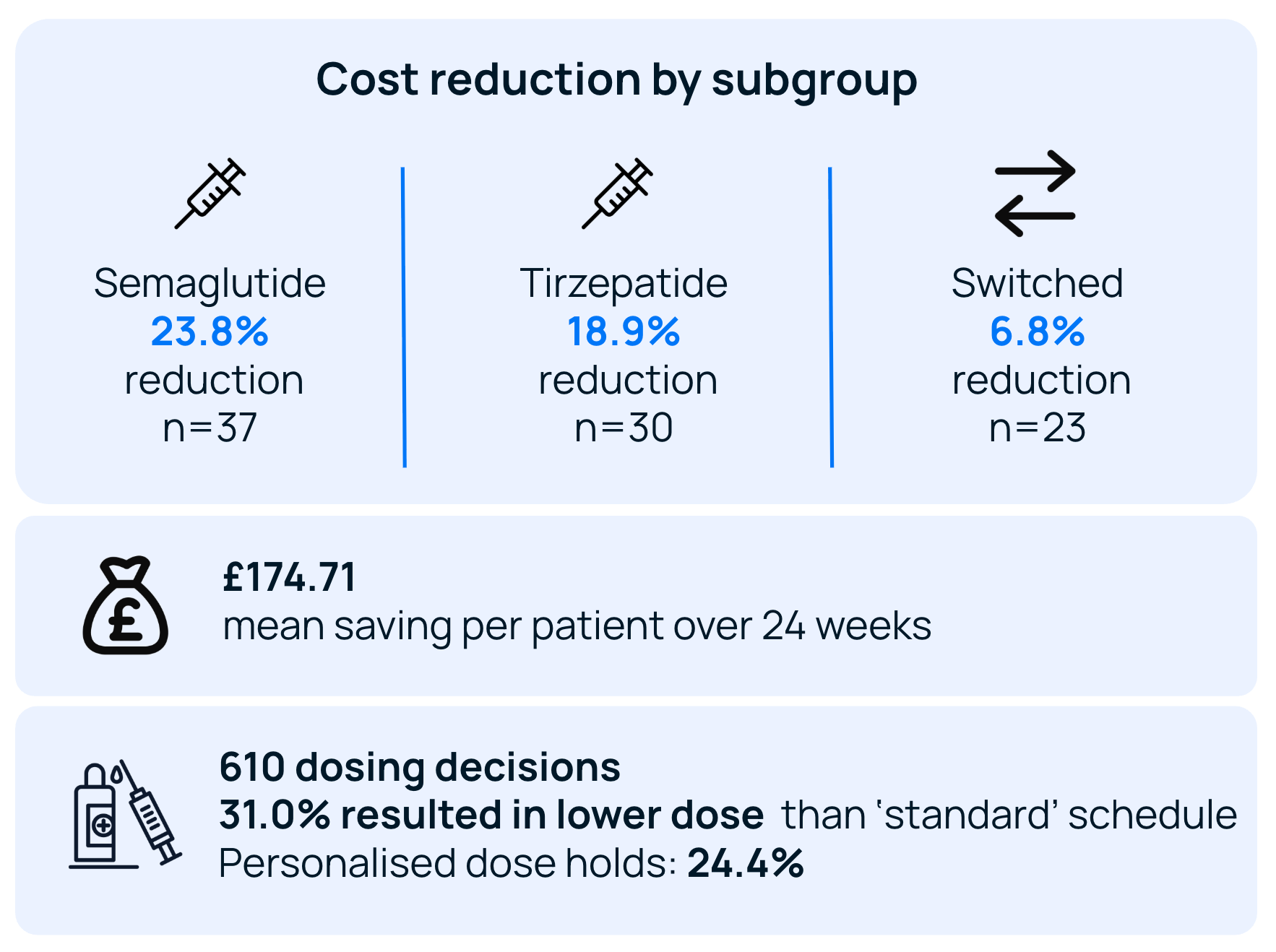
90 patients completed 24 weeks of treatment (Retention: 95.7%; initiating medication: semaglutide [n=58], tirzepatide [n=32]), achieving a mean weight loss of 10.3±5.3% (n=86). Actual drug spend was 17.9% lower than the standard model predicted (£801.03 vs £975.74), representing a mean saving of £174.71 per patient over six months. Cost savings were observed across all subgroups: semaglutide (n=37; 23.8% reduction), tirzepatide (n=30; 18.9% reduction), and switchers (n=23; 6.8% reduction). Of 610 dosing decisions, 31.0% resulted in a dose that was lower than the standard schedule, primarily through personalised dose holds (24.4%).
Conclusion:
In an NHS cohort, real-world medication costs were approximately 18% lower than a standard titration schedule suggests during the six-month initiation window. This cost efficiency appears driven by personalised titration. Investing in services that support personalised dosing approaches may reduce costs, whilst maintaining high retention and weight loss outcomes.